ovarian tissue cryopreservation
menopause delay calculator
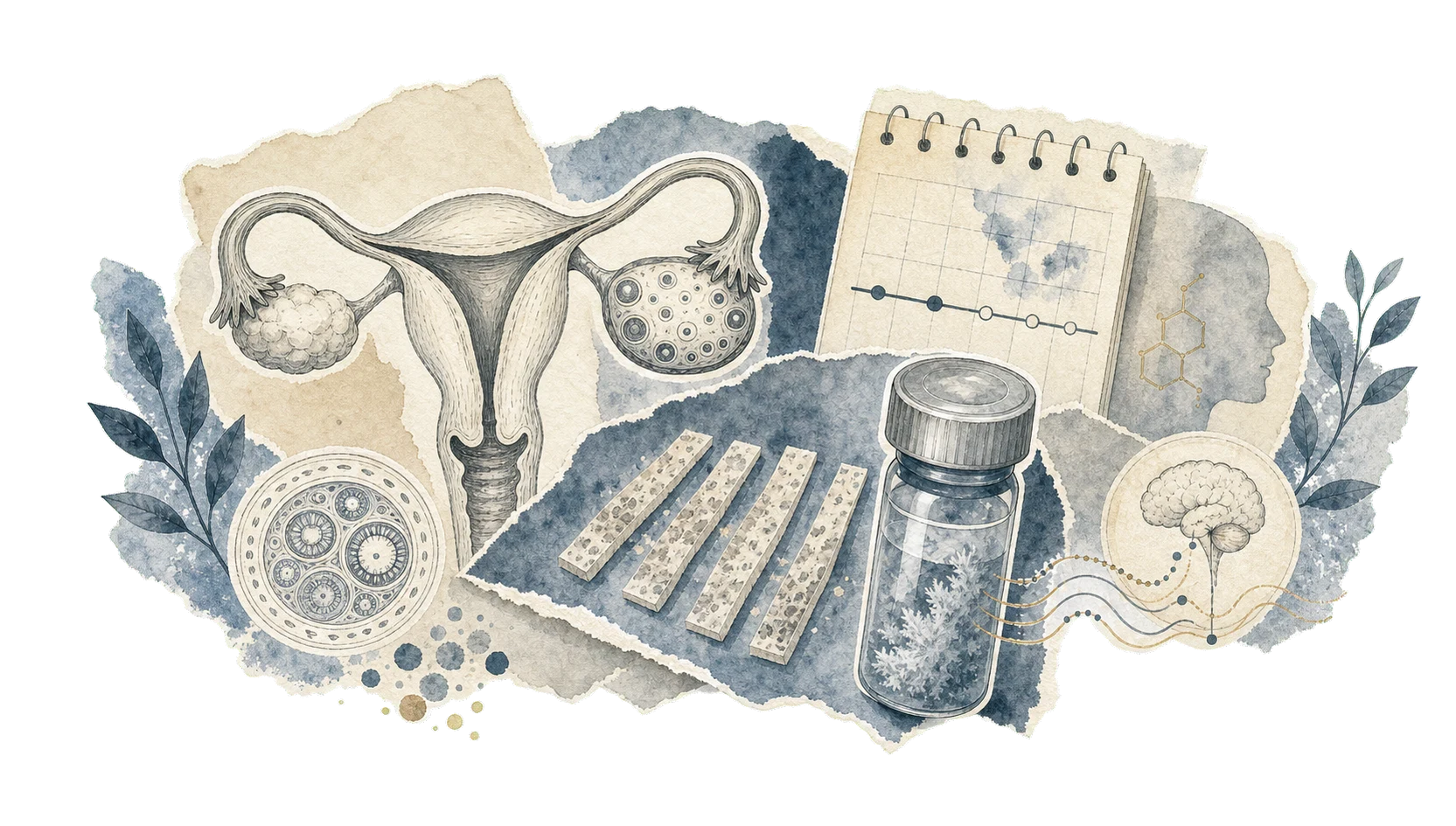
Menopause begins when the ovarian follicle pool is depleted enough that cycles and ovarian hormone production stop. Ovarian tissue cryopreservation freezes cortex containing primordial follicles, then later grafts strips back so surviving tissue can revascularize and function again.
inputs
modeled outcome
within the window
11.9years
- harvest
- age 25
- baseline ANM
- age 51
- if never grafted
- age 49.4 (-1.6)
- projected ANM
- age 62.9 (+11.9)
D = (1/λ) ln(1-p) + (R/λ) ln(1 + (p s / R) e^(λ(T₀-t₀)))
reserve band and max-delay case
Two people the same age can carry very different follicle reserves. The graph keeps your inputs fixed and shifts the assumed natural menopause age by about 3.7 years in either direction, roughly matching the lower, median, and higher reserve cases used by the NoPauze model. The band is reserve percentiles: 10th to 90th. AMH, antral follicle count, ovarian history, and family history are what help locate a person inside it.
modeled delay, years
10th-90th reserve percentile band
- lower reserve / 10th pct
- 8.7 yr; baseline 47.3, projected 56.0
- median reserve
- 11.9 yr; baseline 51.0, projected 62.9
- higher reserve / 90th pct
- 15.0 yr; baseline 54.7, projected 69.7
max-delay scenario
With the same harvest age, survival, and baseline menopause age, the max-delay case removes 50% of cortex and returns it in 3 grafts. That projects a 30.7-year delay, with menopause around age 81.7.
The cost shows up before transplant: if that 50% harvest is never grafted back, modeled menopause moves to age 47.1.
Egg freezing stores eggs for later IVF. Ovarian tissue cryopreservation stores pieces of ovarian cortex, the outer layer of the ovary that contains primordial follicles. If that tissue is later thawed and grafted back, surviving follicles can grow again and the graft can produce ovarian hormones.
The model comes from a 2024 paper in the American Journal of Obstetrics and Gynecology. The main variables are age at harvest, how much cortex is removed, follicle survival after transplant, and whether the banked tissue is returned all at once or in fractions. The accessible paper summary does not add AMH to the equation; it reports examples for a woman with median ovarian reserve.
the age is not the whole answer
"Too late" is not a fixed age. A harvest at 38 can still model a real delay if enough tissue is banked, survival is high, and the tissue is returned in stages. A harvest at 25 can underperform if graft survival is poor or ovarian reserve is far below median. The verdict here is based on modeled years gained.
what makes the number move
Survival and fractionation move the result the most. In the paper's example, a 25-year-old with median reserve, 25% cortex removed, one return, and 40% follicle survival gets an estimated 11.9-year delay here. At 80% survival the delay rises to 15.6 years. Split that same tissue into repeated returns and the model extends further, because tissue that remains frozen is not losing follicles in the body.
Removing cortex also has a cost if the tissue is never used. The "if never grafted" case removes tissue from the ovary but never returns the frozen cortex later, so the modeled menopause age moves earlier.
what would make this more predictive
A personal estimate would need measured reserve. AMH, antral follicle count, age, prior ovarian surgery, endometriosis, chemotherapy exposure, and family history of early menopause all change the interpretation. AMH is useful clinically because it helps estimate current ovarian reserve and likely response to stimulation, but it is not a direct input in this closed-form calculator. Adding an AMH slider without a validated conversion into primordial follicle reserve would make the number look more precise than it is.
egg freezing first
Egg freezing and ovarian tissue freezing solve different problems. Egg freezing is the established route for future IVF: stimulate the ovaries, retrieve mature eggs, and freeze those eggs directly. Ovarian cortex freezing banks immature follicles inside tissue. That tissue can later be transplanted back to restore ovarian activity; future lab maturation of eggs from stored cortex may become useful for IVF, but it is not routine clinical practice now.
If the goal includes future IVF, eggs should usually be banked before elective cortex removal. Even a conservative ovarian tissue procedure removes at least 10% of the modeled cortex here. Removing cortex reduces the follicle pool available for stimulation, so egg retrieval before the tissue surgery is the cleaner sequence. Some people will want one round; others may need multiple rounds to bank a useful number of mature eggs.
The menopause-delay use case is different. It depends on transplanting cortical strips back later so surviving follicles revascularize and resume endocrine function. Egg freezing preserves a chance at embryos later; it does not delay menopause.
what the procedure involves
Ovarian tissue cryopreservation starts with surgery to remove ovarian cortex. In current clinical use this is usually done laparoscopically. The cortex is cut into thin strips and frozen for storage. The tissue can stay frozen for years because follicles are metabolically paused while stored.
1 the cortex is the follicle-rich outer layer of the ovary.
2 a laparoscopic surgery removes a portion of cortex.
3 the cortex is prepared as thin strips for freezing.
4 freezing pauses follicle loss while the strips are stored.
5 after transplant, new vessels feed surviving follicles so the graft can resume hormone function.
To use the tissue later, the strips are thawed and transplanted back into the body, often onto or near remaining ovarian tissue. The graft then has to reconnect to a blood supply. This early ischemic period is why follicle survival matters so much in the calculator: once the graft revascularizes, oxygen and nutrients can reach surviving follicles. Lost follicles cannot contribute to later ovarian hormone production.
The technique was developed for fertility preservation before cancer treatment and has produced pregnancies after transplantation. Using it electively to delay menopause is a newer question. The calculation does not remove the surgical risks, uncertainty around graft survival, or the need to measure ovarian reserve before treating the output as personal.
receipts
- Johnson J, Lawley SD, Emerson JW, Oktay KH. Modeling delay of age at natural menopause with planned tissue cryopreservation and autologous transplantation. Am J Obstet Gynecol. 2024;230:426.e1-8. PubMed
- Original reference page: NoPauze Calculator
- ASRM Practice Committee. Fertility preservation in patients with medical indications. Committee opinion, 2026. ASRM
- Dalal PK, Agarwal M. Menopause. StatPearls, updated 2026. NCBI Bookshelf